
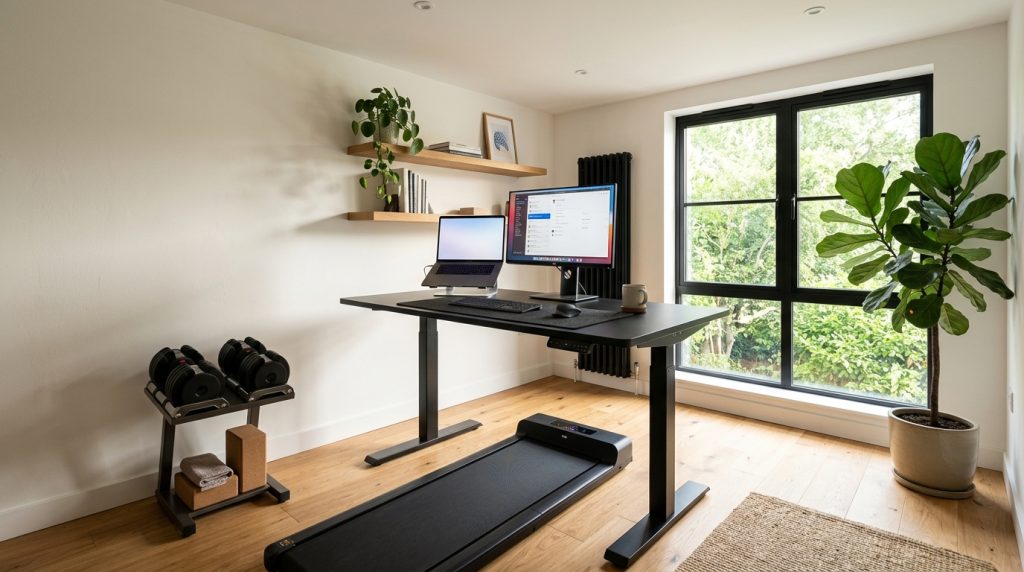
A technical, biomechanical and ergonomic analysis of how to structure a high-performance home environment, break workplace sedentarism with under-desk walking, and select durable equipment without wasting space.
The traditional concept of «setting up a gym at home» carries a well-deserved historical stigma: spare rooms crammed with bulky machines bought on impulse that, after three weeks of enthusiasm, end up as thousand-euro clothes racks. The friction of space, the visual clutter and the limited versatility of conventional commercial machines have frustrated thousands of people seeking to reconcile their physical health with everyday life.
In recent years, however, the convergence of exercise science, compact materials engineering and the need to combat the workplace sedentarism of remote work has given rise to a radically different paradigm: the high-stimulus-density home gym. A smart approach where the goal is not to replicate a commercial fitness center, but to select versatile tools for strength and to revolutionize daily energy expenditure by combining ultra-thin flat walking pads and height-adjustable desks.
1. The Pillars of Strength at Home: Less Metal, More Stimulus
Building muscle mass, preserving bone density and optimizing insulin sensitivity does not require a dozen single-joint pulley machines. Hypertrophy and strength respond to invariable biological principles: mechanical tension, recruitment of high-threshold motor units and progressive overload.
In a home environment with limited space, the investment hierarchy should always prioritize tools that allow you to execute the great human movement patterns (push, pull, squat, hip hinge and carry):
- Sturdy Adjustable Bench (0° to 85°): This is the cornerstone. A bench with a thick steel frame and high-density upholstery multiplies the variants of dumbbell presses, chest-supported rows, raises and arm work while taking up less than a square meter.
- Adjustable or Quick-Load Dumbbells: They replace an entire wall of fixed dumbbells. Dial systems or modular plates let you vary the load from 2 kg up to 32–40 kg per dumbbell in seconds, offering a progression range for years of serious training.
- Multi-Stations and Compact Racks: For those who have a garage or a dedicated corner of at least 3×3 meters and seek maximum guided comfort, turning to integrated structures such as the multi-stations and strength-training machines from 100×100 Fitness guarantees absolute safety when lifting heavy without the need for a spotter, grouping high and low pulleys and the press into a single physical footprint.
2. The Dilemma of Traditional Cardio versus Metabolic Conditioning
The second great home mistake is buying a conventional athletic treadmill to place in an apartment. These machines usually weigh more than 80 kg, are noisy for neighbors due to the impact of running, and their size turns them into a permanent obstacle that mars the livability of any room.
If the goal is intense metabolic conditioning and the development of lung capacity (high intensity / HIIT intervals), contemporary biomechanics favors tools for full-body traction without joint impact, such as the resistance rowing machines from 100×100 Fitness, which can be stored upright against the wall, taking up barely the surface of a chair.
3. The Silent Revolution: Flat Walking Pads and Height-Adjustable Desks
While strength requires concentrated sessions of 45 to 60 minutes, the greatest enemy of contemporary health is not the lack of vigorous exercise, but accumulated static sedentarism. Millions of professionals spend between 8 and 11 hours a day sitting in front of the computer. Various studies in vascular physiology have shown that remaining motionless for more than 60 consecutive minutes causes:
- Inhibition of Lipoprotein Lipase (LPL): The key enzyme responsible for breaking down triglycerides in the blood and facilitating fatty-acid uptake drops by more than 90% in the inactive muscles of the legs.
- Acute Insulin Resistance: Non-insulin-mediated glucose uptake (via GLUT4 transporters) shuts down completely in the absence of tonic muscle contractions.
- Postural Collapse and Shortening of the Flexors: The iliopsoas remains in passive contraction, reciprocally inhibiting the gluteus maximus (gluteal amnesia) and forcing the lumbar curve into retroversion.
This is where the pairing of motorized standing desks and flat walking pads has brought about the most disruptive transformation in productivity and health of the last decade.
The Metabolic Power of NEAT (*Non-Exercise Activity Thermogenesis*)
Walking slowly at a constant speed of 2.5 to 3.5 km/h while you answer emails, read documentation or take calls does not generate noticeable sweating or quicken your breathing (keeping you comfortably in cardiovascular Zone 1). Yet the biological implications are massive:
- Passive accumulation of volume: Over a workday with two 60-minute walking blocks, you accumulate between 7,000 and 10,000 additional steps without having set aside extra time outside of work.
- Caloric expenditure without CNS fatigue: You burn between 250 and 400 net kcal a day without generating fatigue in the central nervous system or negatively interfering with your recovery from heavy strength sessions.
- Activation of the calf muscle pump: The soleus and gastrocnemius actively pump venous blood back to the heart, preventing heavy legs, varicose veins and the blood-pressure spikes associated with prolonged stasis.
Technical Keys to Choosing a Walking Pad and an Adjustable Desk
Not just any pad works for a desk setup. For the experience to be smooth and sustainable over time, it’s worth verifying the following technical specifications:
- Ultra-Thin Flat Walking Pads: They must lack bulky handrails so they slide cleanly under the tabletop. It is essential to choose models with quiet brushless motors (sound level below 45 dB so as not to disrupt meetings), an extra-flat profile 10 to 13 cm thick that allows them to be stored under the bed or sofa thanks to integrated wheels, and a speed range adjustable from 0.8 up to 6 km/h (you can compare the top-rated models of under-desk flat walking pads on Amazon).
- Height-Adjustable Desks (*Standing Desks*): Structural stability is critical. When walking, any play in the desk legs translates into an annoying wobble of the monitors. It is recommended to opt for structures with a dual electric motor (one in each leg), panels with pre-programmed height memory and a lifting capacity of up to 120–125 cm to adapt to the combined height of the user standing on the pad base (check out the range of electric standing desks on Amazon).
4. Postural Alternation Protocol: The 60 / 30 / 30 Guideline
The most common beginner’s mistake is going from sitting for 8 hours to trying to work 8 hours standing or walking, which overloads the plantar fascia and the lumbar musculature. The human body is not designed to always be sitting, but neither is it designed to remain motionless while standing.
The most efficient biomechanical protocol consists of modulating the workday into two-hour cycles:
- Block 1: Seated, deep focus (60 minutes): Tasks that require maximum fine motor precision (design, complex programming, high-concentration analytical writing).
- Block 2: Gentle walking on the flat pad at 2.5–3 km/h (30–40 minutes): Reviewing emails, follow-up meetings, reading reports or listening to presentations.
- Block 3: Static standing with alternating support (20–30 minutes): Quick calls or active breaks with neck stretches and hip opening.
5. Comparison: Options for Training and Moving at Home
| Setup | Space Required | Main Physiological Goal | Key Advantage | Return on Investment |
|---|---|---|---|---|
| Walking Pad + Standing Desk | Minimal (uses the workspace itself) | Zone 1 cardio, massive NEAT, metabolic and circulatory health | Multiplies caloric expenditure without subtracting leisure hours or generating nervous fatigue | Maximum: Pays for itself in health and work productivity every day |
| Adjustable Bench + Adjustable Dumbbells | 1 to 2 m² | Strength, muscle mass and bone density (overall hypertrophy) | Total versatility to train the whole body in minutes | Very High: Virtually infinite durability with no maintenance |
| Foldable Rowing Machine | 2 m² in use / 0.5 m² stored upright | Low-impact aerobic and anaerobic conditioning | Recruits 85% of the muscle mass without joint impact | High: Ideal for intense 20–30 min sessions |
| Strength-Training Multi-Station | 4 to 6 m² dedicated | Heavy guided strength and safe muscle isolation | Allows lifting submaximal loads without external help | Medium-High: Requires exclusive fixed space |
Ultra-Slim Walking Pad Treadmill
Compact design with a silent brushless motor and remote control, perfect for racking up steps under adjustable standing desks or storing away beneath the sofa.
* As an Amazon Associate, Trebellos earns from qualifying purchases.The Trebellos Verdict
The home gym is not a matter of accumulating machines, but of eliminating the everyday frictions that keep you from moving. If you train strength two or three times a week with a bench and free weights, and transform your sedentary hours of screen time into thousands of gentle steps thanks to an adjustable desk and a flat walking pad, you will have solved, in one fell swoop, 90% of the physical challenges of the modern lifestyle without the need for commutes or monthly fees.
Transparency notice: This article contains recommendation links affiliated with affiliate programs (Amazon and TradeTracker). As an Amazon Associate and authorized partners, we earn income from qualifying affiliated purchases at no additional cost to you. Our selections always respond to technical, biomechanical and proven-quality criteria.